
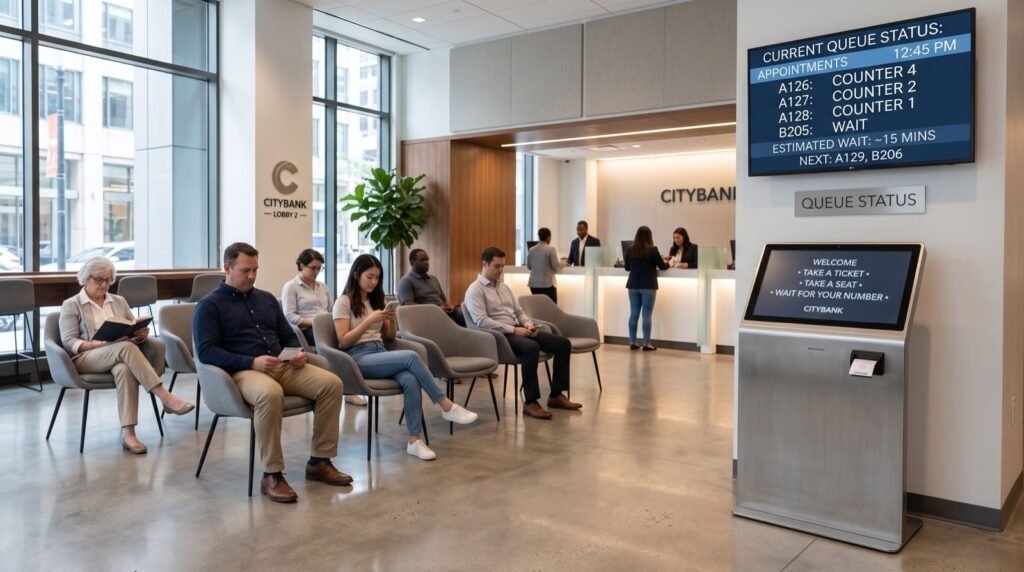
Queue Management System in Saudi Arabia: A 2026 Buyer’s Guide for Smart Branches
A modern queue management system in Saudi Arabia is no longer a nice-to-have accessory sitting near the entrance of a bank or a clinic. It has become part of the core communications stack that ties together customer experience, staff productivity, and the digital transformation goals set out under Vision 2030. When we install and tune these systems for banks, hospitals, government service centres, and telecom retail outlets across the Kingdom, the goal is always the same: turn a chaotic waiting hall into a calm, measurable, and predictable flow of people.
This 2026 guide walks through what a queue management system actually does, how the hardware and software fit into your existing IT and telephony infrastructure, and how to choose a platform that will still serve you well three or four years from now.
What Is a Queue Management System and Why It Matters in 2026
At its simplest, a queue management platform issues tickets, organises visitors into the right service lines, calls them to counters, and records every step so managers can see exactly where time is being lost. In practice, a well-designed system in Saudi Arabia does far more than print numbered slips.
It connects to digital signage, sends SMS or WhatsApp notifications, feeds live dashboards, and integrates with the counter phones and unified communications tools your staff already use. Because so many branches now handle both walk-in and appointment-based traffic, the system also has to blend physical queues with online bookings without double-booking a single counter.
- Ticketing kiosks that support Arabic and English, print or send a virtual ticket, and let customers pick a service category.
- Counter and calling software that lets an agent call the next visitor, transfer them to another service, or park them for a supervisor.
- Digital signage and audio calling so visitors always know which counter to approach.
- Analytics and reporting covering wait time, service time, no-shows, and peak-hour staffing needs.
How a Queue System Fits Into Your Broader IT and Telecom Stack
The biggest mistake we see is treating the queue system as an island. In reality, it should sit alongside your network, your IP telephony, and your structured cabling as one connected environment. Ticket kiosks and counter displays ride on the same LAN, calling audio can route through the same PoE switches feeding your desk phones, and the whole platform benefits from a resilient network backbone.
When branches deploy IP phones at each service counter, agents can escalate a complex case to a specialist by voice while the visitor is still in front of them. Pairing the queue platform with quality desk endpoints such as the Addasound Epic 511 headset keeps agents hands-free and reduces the background noise that makes crowded halls so stressful for both staff and customers.
For businesses standardising on a full unified communications rollout, choosing the right desk endpoints, cabling, and queue software together avoids the painful re-work of retrofitting one system to another later. Working with dependable specialists who understand both the networking and the customer-flow side keeps every layer talking to the next.
Key Features to Compare Before You Buy
Not every platform is built for the volume and language requirements of the Saudi market, so evaluating a queue management system in saudi arabia means checking it against local expectations rather than a generic spec sheet. The table below summarises the capabilities we advise clients to confirm before signing anything.
| Feature | Why It Matters | Priority in 2026 |
|---|---|---|
| Bilingual Arabic/English interface | Serves all visitors and meets local expectations | Essential |
| Virtual and mobile ticketing | Lets visitors wait remotely and cuts crowding | Essential |
| Appointment integration | Blends online bookings with walk-ins | High |
| Real-time analytics dashboard | Reveals bottlenecks and staffing gaps | High |
| SMS / WhatsApp notifications | Reduces no-shows and improves experience | High |
| API and CRM integration | Connects to your existing systems of record | Medium to High |
| Centralised multi-branch view | Compares performance across locations | Medium |
Measuring the Return on a Queue Management Investment
Decision-makers rightly ask what they get back. In the deployments we manage, the returns cluster around three areas: shorter perceived wait times, better use of staff, and cleaner data for planning.
- Perceived wait time drops. Even when raw service time is unchanged, visitors who receive a ticket, an estimated wait, and a notification feel far less frustrated.
- Staff utilisation improves. Managers can shift agents to high-demand services at peak hours instead of guessing.
- Planning gets data-driven. Historical reporting shows exactly when to add counters or extend opening hours.
Research from customer-experience bodies has long shown that unmanaged waiting is one of the strongest drivers of dissatisfaction. Government guidance on public-service delivery, such as the resources published by the UK Government Service Manual, repeatedly stresses that reducing friction in service journeys pays off in measurable trust and repeat use — a principle that applies just as strongly to Saudi service centres.
Which Sectors Benefit Most From Queue Management?
While almost any high-footfall venue gains from structured queuing, some sectors see outsized results:
- Banking and finance — where compliance steps make service times variable and priority routing matters.
- Healthcare and clinics — where separating triage, pharmacy, and billing lines prevents dangerous crowding.
- Government and municipal offices — where document services generate long, multi-step visits.
- Telecom and retail stores — where a blend of quick top-ups and long device consultations must coexist.
Frequently Asked Questions
How long does it take to install a queue management system in Saudi Arabia?
A single-branch deployment typically goes live within one to three weeks once the network points and displays are ready. Multi-branch or heavily integrated projects take longer because of CRM connections, testing, and staff training, but a phased rollout keeps disruption minimal.
Can a queue system integrate with our existing phones and network?
Yes. A properly specified platform runs on your existing LAN, uses PoE switches shared with your IP telephony, and exposes APIs so it can talk to your CRM or booking tools. Planning the cabling and network capacity up front avoids costly changes later.
Does a queue management system support Arabic language and RTL layouts?
Reputable systems ship with full bilingual Arabic and English support, right-to-left layouts, and Arabic voice calling on the audio announcements. This is a baseline requirement for any serious deployment in the Kingdom.
What ongoing costs should we budget for?
Beyond the hardware and software licence, budget for annual support, occasional consumables like ticket paper, and any premium notification channels such as WhatsApp Business messaging. A good partner will make these costs transparent before purchase.
Conclusion: Build a Flow That Scales
A well-chosen queue management system in Saudi Arabia pays for itself by turning waiting into a controlled, measurable process and by connecting cleanly to the network, telephony, and analytics tools your branches already rely on. Treat it as part of your unified communications strategy rather than a standalone gadget, insist on bilingual support and solid integration, and you will have a platform that scales with your business well beyond 2026. Talk to a specialist team about a pilot in one branch, prove the numbers, and roll out from there.